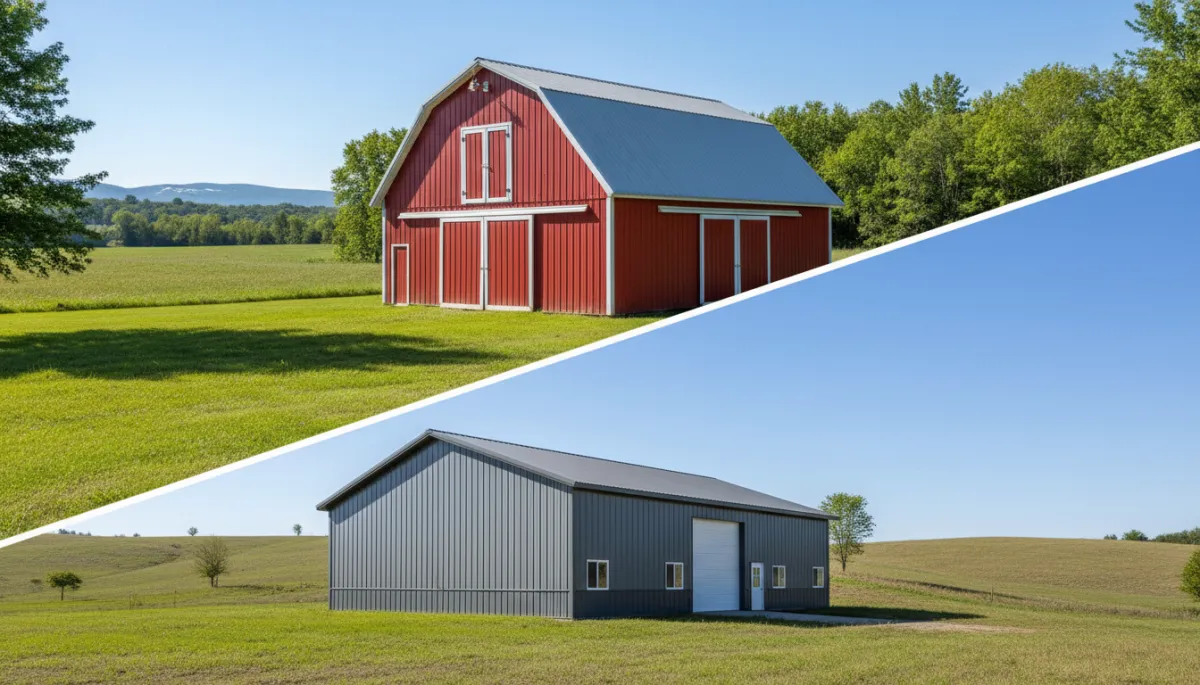
Pole Barn vs. Steel Building: Choose the Best Option
Construction, Pole Barns, Steel Buildings, Western New York
Pole Barn or Steel Building: How to Pick the Right One for Your Property
If you own property around Jamestown, Chautauqua County, or anywhere in Western New York, a good outbuilding isn’t a luxury—it’s almost a necessity. Between lake-effect snow, muddy springs, and four full seasons of projects, you need storage and workspace that actually fits the way you live. The big question is usually the same: should you go with a pole barn or a steel building? Let’s break down the differences so you can feel confident about what belongs on your land.
Pole Barn Basics: Simple, Fast, and Budget-Friendly
A pole barn is built around wood post-and-beam construction. Treated posts are set in the ground or on piers, girts and trusses tie everything together, and metal panels usually finish the exterior. It’s a straightforward system that’s been proven on farms and rural properties for decades.
In Western New York, pole barns are popular because they’re cost-effective and quick to build. Recent cost guides put contractor-built shells with a concrete slab in the roughly $18–$55 per square foot range in upstate New York, with a 40×60 pole barn often landing around $36,000–$58,000 depending on finishes and site conditions (polebarncosts.com, 2026). For most homeowners, that’s a very friendly way to add 1,200–2,400 square feet of usable space.
Pole barns shine as personal storage, equipment sheds, horse barns, and workshops. They look right at home on rural and edge-of-town properties, and they’re easy to customize with doors, overhangs, and interior layouts. Lewis Contracting has been building pole barns across Western New York for 28 years, so they know how to match a design to your land, your budget, and our local weather.
Steel Buildings: Heavy-Duty Space Built for the Long Haul
Steel buildings use a steel frame structure—rigid frames, purlins, and girts—with metal panels on the roof and walls. The big advantages are durability, strength, and longer lifespan. Properly designed and maintained, a steel building can shrug off decades of weather with minimal fuss, which is a big deal when you’re investing in larger square footage or commercial operations.
Up front, steel buildings usually cost more than pole barns. Nationally, installed steel shells often run around $18–$26 per square foot, with turnkey, more finished setups in the $30–$45+ per square foot range in regions like Western New York (akoetech.com, 2026). The trade-off is that steel really pays off on larger spans—think clear, open floor space without rows of posts in the way—making them ideal for industrial, commercial, or larger agricultural use.
Around Jamestown and the Chautauqua Ridge, snow load is not something you guess at. Our lake-effect storms can dump serious weight on a roof. Current New York codes use ASCE 7-22 snow-load maps, and ground snow loads in Western NY can run in the 40–65 psf range or higher depending on your exact spot and elevation (dos.ny.gov; design.medeek.com; roofvista.com). That’s why structural specs matter so much. Lewis Contracting has extensive experience with steel buildings and works within these updated codes so your building is engineered to handle real-world snow, not just pretty weather on paper.
How to Choose: Cost, Longevity, and How You’ll Use It
So which one fits your property better—a pole barn or a steel building? It usually comes down to three things: cost per square foot, expected lifespan, and what you’re actually doing inside the building.
Cost per square foot: For a straightforward shell, pole barns often come in a bit lower, especially on small to mid-size buildings. Steel buildings may cost more up front but can be more economical for very large footprints or taller clear spans.
Longevity: Wood-framed pole barns hold up well when built right and maintained, but steel buildings typically win on pure lifespan and resistance to pests, rot, and everyday wear.
Typical use cases: Pole barns are great for personal storage, equipment, hobby shops, horse barns, and small farm operations. Steel buildings are better suited to commercial storage, larger agricultural operations, and industrial use where big clear spans and heavy-duty performance matter.
💡 Quick reality check: In snow-prone Western NY, structural strength is non-negotiable. Whether you pick wood posts or steel frames, make sure your design is engineered for your site’s actual snow load—especially if you’re in a lake-effect belt or higher elevation.
At the end of the day, there’s no one “right” answer—just the right trade-offs for your property. A well-built pole barn might be perfect for your tractors, toys, and workshop. A steel building might make more sense if you’re planning serious commercial storage or a long-term agricultural or industrial setup. Talk through your budget, snow-load requirements, and long-term plans with a builder who knows Western New York. When you understand the pros and cons of each option, picking the right building feels a lot less stressful—and a lot more like an investment you’ll be happy with for years.

Steel buildings excel when you need big, open space that lasts for decades.

